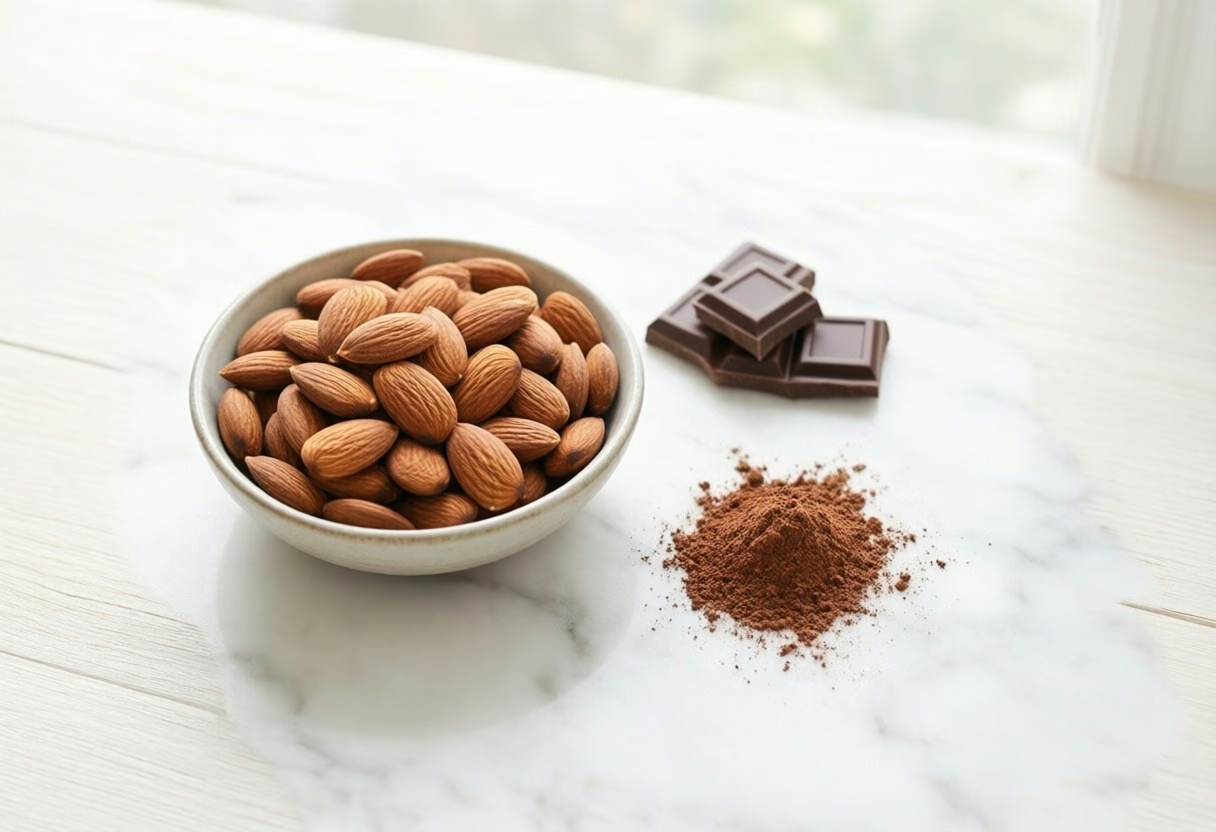
Almonds and dark chocolate both get credit for heart and metabolic health, and their fiber and flavanols are often said to feed the gut microbiome. This trial put that idea to a real, if small, test: what happens to stool bacteria when almonds, dark chocolate with cocoa, or both replace some of the butter, cheese and crackers in a typical diet? The effects were modest.
How the study worked
This is a secondary analysis of a controlled-feeding crossover trial in adults with overweight or obesity. Forty eight participants were randomized and 31 completed the trial. Only 21 provided stool samples (87 samples in total; 10 women and 11 men; age 44.3 ± 9.2 years; BMI 29.3 ± 2.8 kg/m2).
Each participant went through four feeding periods (4-weeks per period). They ate either an average American diet (AAD) or a similar diet containing one of the test foods, which replaced an isocaloric amount of butter, cheese and crackers:
- 42.5 g of raw almonds (ALD, 253 kcal/d)
- 43 g of dark chocolate plus 18 g of cocoa (CHOC, 251 kcal/d)
- both together (CHOC + ALD, 504 kcal/d)
Richness and evenness were assessed with the number of observed taxa, the Chao1 index and Pielou's evenness. Overall community dissimilarity was tested with the Bray-Curtis index, and individual bacterial groups with linear mixed models.
What the researchers found
Almonds alone were associated with a change in the overall community. Stool microbial communities on the almond diet were dissimilar to pre-study samples (p = 0.021), to the AAD (p = 0.036) and to the chocolate diet (p = 0.025).
Two individual bacterial groups moved:
- Lactococcus (family Streptococcaceae) was lower than on the AAD after CHOC (log-fold difference: -3.7 [95% CI: -6.69, -0.71]), ALD (-4.22 [-7.33, -1.11]) and CHOC + ALD (-5.03 [-7.98, -2.08]).
- Bilophila (family Desulfovibrionaceae) was higher after CHOC than on the AAD (2.41 [0.75, 4.07]) and higher after CHOC than after CHOC + ALD (1.72 [0.14, 3.29]).
No other differences in stool microbial diversity or composition were observed, and none were reported for richness or evenness.
What this does not tell us
- Small and partial. Only 21 of 48 randomized participants (44%) contributed stool samples, and this was a secondary analysis of a trial designed around other outcomes.
- Bacteria, not health. The study measured which microbes were present. It did not show that these shifts help or harm anyone, and the abstract does not say what the changes in Lactococcus or Bilophila mean clinically.
- A swap, not an addition. Because the test foods replaced butter, cheese and crackers, a change could reflect what was removed as much as what was added. Lactococcus is a dairy-associated genus, so the drop may partly reflect less cheese and butter. That is our speculation, not something the authors tested.
- Short exposure. Each diet lasted four weeks.
The abstract does not state funding or competing interests, and we did not verify them.
Our reading: almonds and dark chocolate are reasonable foods, but this trial gives no reason to expect a gut-microbiome overhaul from adding them. Treat them as part of a varied diet, not a probiotic.
This article is for general education and is not medical advice.