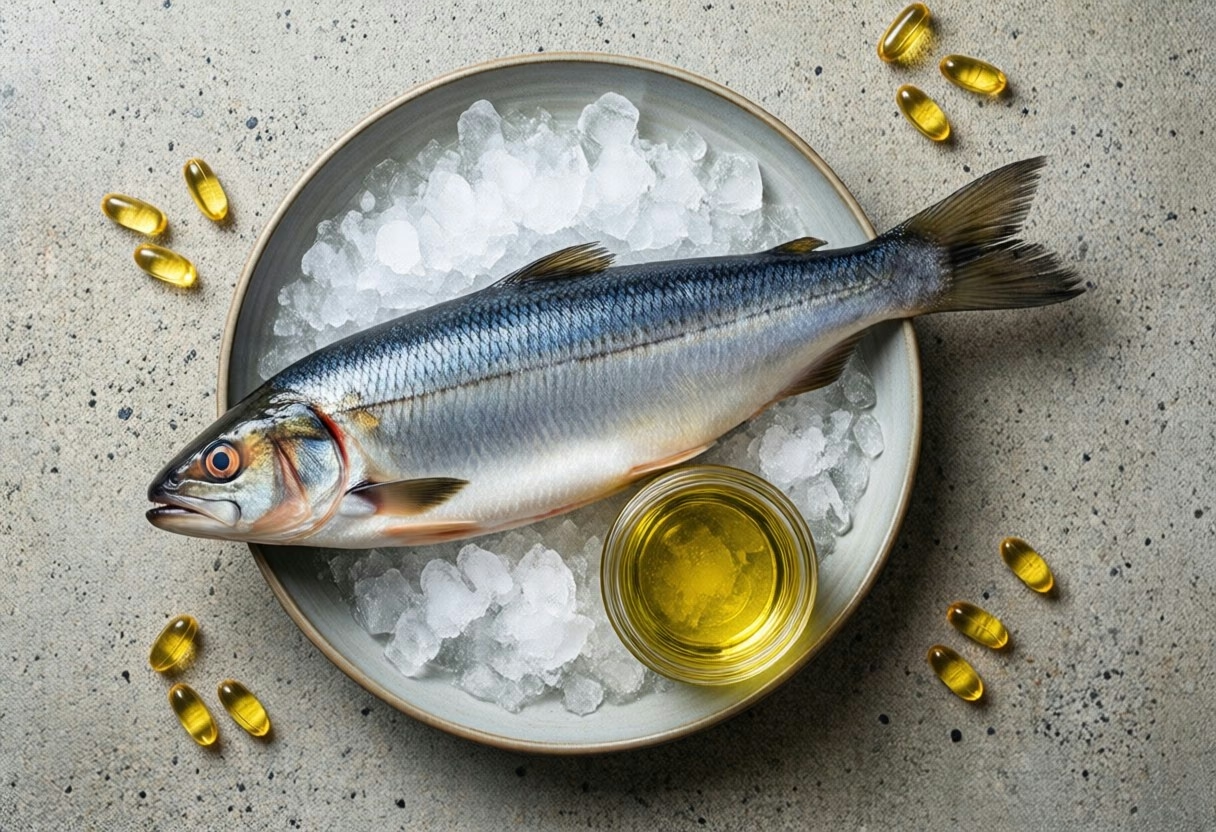
Fatty fish gets credit for heart health mostly through EPA and DHA, the well-known omega-3s. But in typical doses, EPA and DHA don't actually lower LDL-cholesterol. A research group in Bergen has spent several years asking whether a different, less familiar fat in herring — an omega-11 monounsaturated fat called cetoleic acid — might be doing some of that work instead. Their first human trial is now out.
What was tested
The trial enrolled 80 adults with overweight or obesity; 75 completed it and were analyzed. For 8 weeks, one group took capsules with a cetoleic acid concentrate (1,480 mg cetoleic acid plus 232 mg EPA per day, the "CECO" group, n=37), while the comparator group took soybean oil blended with an n-3 concentrate and no cetoleic acid (258 mg EPA per day, the "SOYO3" group, n=38).
What changed
LDL-cholesterol fell in the cetoleic acid group (median change -0.1 mmol/l, quartiles -0.1 to 0.0) while it rose in the comparator group (median change +0.2 mmol/l, quartiles +0.1 to +0.2). The difference between groups was statistically significant (F = 19.35, P = 0.033, partial η² = 0.212), corresponding to about a 7% relative reduction in the cetoleic acid group compared with the comparator.
This is the first published randomized trial of cetoleic acid in humans. It builds on earlier work from the same research group in rats fed herring oil rich in cetoleic acid (C22:1n-11), which found much larger drops in plasma lipids: total fat down 58%, triglycerides down 55%, total cholesterol down 41%, and LDL-cholesterol down 45%, alongside a 46% increase in the HDL-to-LDL ratio, over 10 weeks.
Why the human result is smaller, and what it doesn't show
- Rats aren't people, and the doses aren't equivalent. The 41-45% reductions came from rats fed oil making up 5% of their diet; the human dose was a fixed daily capsule. Large animal effect sizes routinely shrink this much, or more, when a hypothesis moves to a human trial — that is a normal part of the process, not a red flag by itself.
- This measures a cholesterol number, not heart attacks or strokes. LDL-cholesterol is a well-established risk marker, but no study has yet tested whether cetoleic acid changes rates of cardiovascular events.
- It was a concentrated supplement, not "eat more herring." The capsule dose (1,480 mg/day) isn't translated in the paper into a serving size of fish, and we could not find a published figure for how much herring would supply that amount.
- One trial, 8 weeks, 75 people. It hasn't been replicated, and longer-term safety and effectiveness are unknown.
Our reading
This is a credible, well-sequenced line of research — mechanism in cells, then rats, now a first human trial with a result in the same direction, just smaller. That is how nutrition science is supposed to build evidence. It is not yet a reason to buy a cetoleic acid supplement or to eat herring specifically for your LDL, and it says nothing new about the general benefits of eating fatty fish, which rest on a much larger body of evidence. Worth watching, not worth acting on yet.
This article is for general education and is not medical advice.