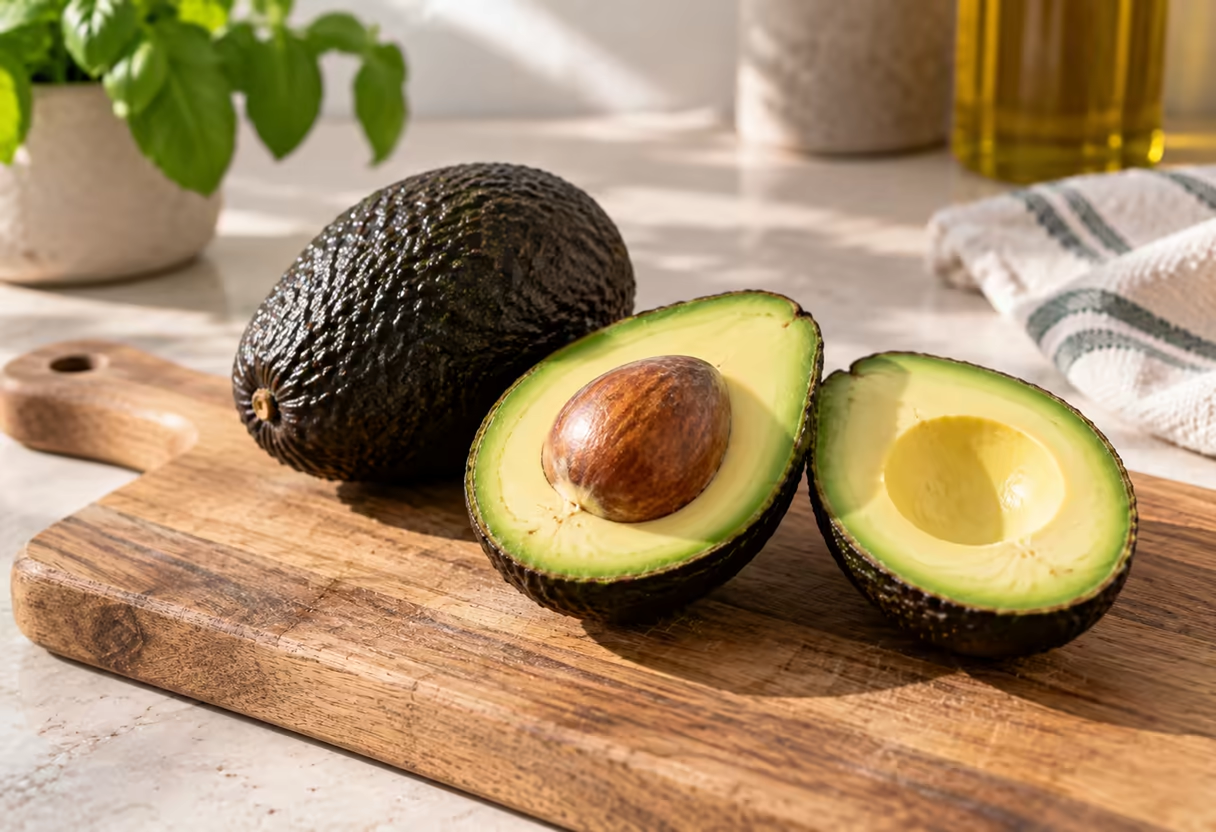
Adding one avocado a day for 26 weeks reduced the number of LDL particles in the blood in a trial of adults with abdominal obesity. The result was specific: ApoB did not fall significantly, and most other particle measures did not differ between groups.
This is an interesting food study, not evidence that everyone needs a daily avocado. It is an exploratory analysis from a larger trial, and the parent study was funded by the avocado industry.
What was tested
The analysis used blood samples from 786 participants in the Habitual Diet and Avocado Trial. The avocado group included 389 people and the usual-diet group 397. Participants were 74% female, with a mean age of 51 ± 14 years and a mean body mass index of 32.9 ± 5.4 kg/m².
The intervention was one large Hass avocado per day for 26 weeks, added to participants’ usual eating rather than supplied as part of a fully controlled menu. The parent trial’s dietary-compliance assessment used 168 g as the study-provided avocado amount; this is the study’s reference quantity, not a claim that every avocado weighs the same. The control group continued its usual diet and was asked to limit avocado to no more than two per month.
Participants knew which group they were in. The parent trial reports that central laboratory staff were blinded to allocation. This new analysis used nuclear magnetic resonance testing of fasting blood samples at baseline and 26 weeks to measure lipoprotein particles and their subclasses.
Fewer particles, not a uniform change in blood lipids
Compared with the usual-diet group, the daily-avocado group had a greater fall in total LDL particle concentration: mean difference -49.1 nmol/L (95% CI -83.6 to -14.5; P = 0.005). The analysis adjusted for study site.
LDL particles carry cholesterol in the bloodstream. Counting those particles is different from measuring how much cholesterol they carry, so this result should not be reported as a 49.1-point fall in an ordinary LDL-cholesterol test. The units are different, too: this measurement is in nmol/L, not mg/dL.
There were no significant between-group differences in LDL particle size or subclasses, triglyceride-rich lipoprotein particles, HDL particles, or apolipoproteins A or B. ApoB is another measure related to the number of potentially artery-damaging particles. Its lack of a significant change limits how broadly we should describe the LDL-particle result.
The study does not establish how much, if at all, this particular change would reduce heart attacks or strokes. Those clinical outcomes were not the endpoints of this analysis.
The larger trial matters
These blood-particle measurements were labeled exploratory outcomes, not the original trial’s main endpoint. The parent trial (N=1008) tested whether daily avocado over 6 months reduced visceral fat, the fat around abdominal organs. It did not: the between-group difference was 0.017 L (95% CI -0.024 to 0.058; P = 0.405).
The current analysis includes the 786 participants with available samples and data, rather than everyone originally enrolled. An exploratory finding in that subset deserves follow-up, particularly when several related markers do not show a difference. The new result should not be repackaged as proof that avocados reduce belly fat.
Funding and competing interests: The new paper declares no competing interests. However, the parent trial was sponsored by the Hass Avocado Board, which also supplied the avocados; its funding statement names the Avocado Nutrition Center. The parent publication says the sponsor did not have access to the trial data files during the study. Industry support does not make a finding false, but readers should know about it.
For someone who enjoys avocado, this is evidence of a possible, specific blood-lipid benefit at the amount tested. It is not evidence that avocado is necessary, that more would be better, or that it can replace prescribed cholesterol treatment.
This article is for general education and is not medical advice.