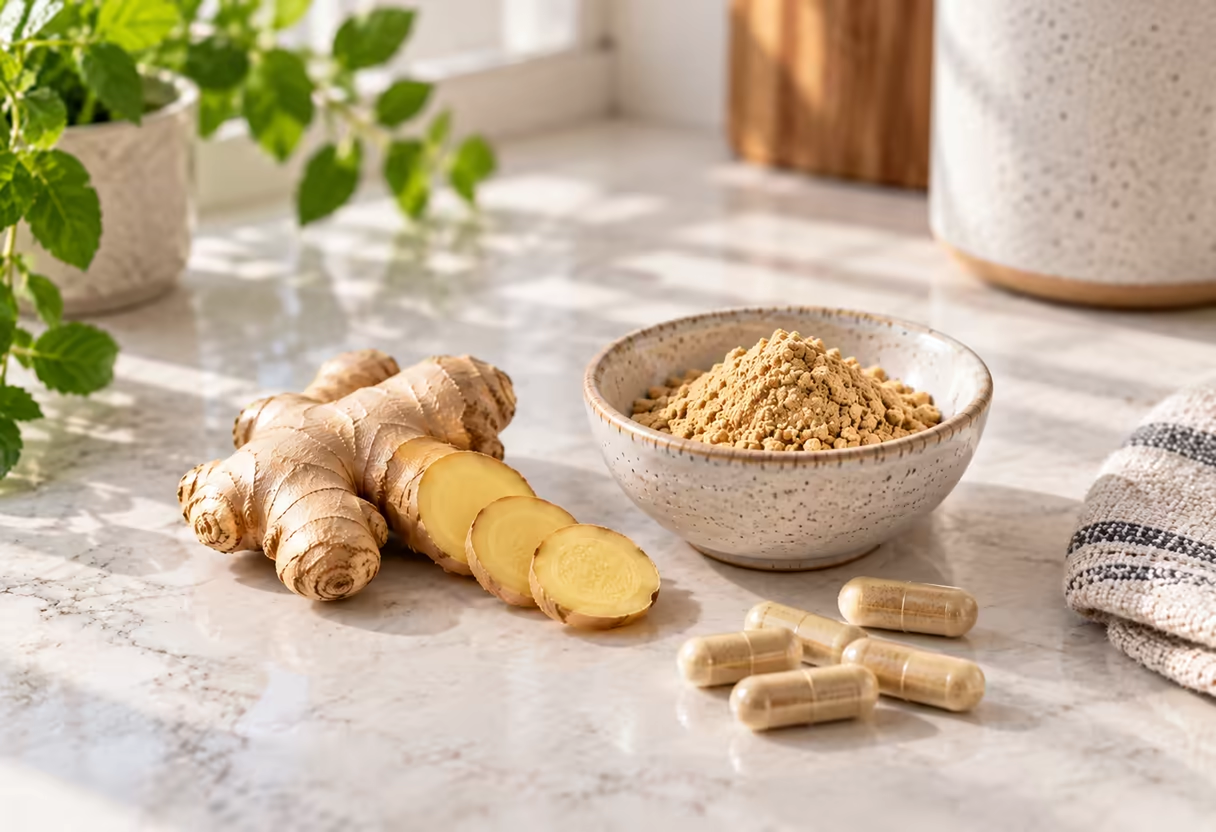
Pooled across 12 randomised trials, ginger supplements lowered systolic blood pressure by 5.03 mmHg. That is the headline from a dose-response meta-analysis published in the Journal of Human Nutrition and Dietetics, the journal of the British Dietetic Association — and it comes with a dose attached, which is the part most coverage of ginger leaves out.
The numbers. Searching the literature through 1 May 2026, the authors found 12 unique randomised controlled trials, contributing 13 effect estimates for systolic pressure and 12 for diastolic. Systolic pressure fell by a weighted mean difference of -5.03 mmHg (95% CI -8.49 to -1.57; p = 0.004). Diastolic fell by -2.03 mmHg (95% CI -3.90 to -0.15; p = 0.034) — statistically significant, but only just, with a confidence interval whose upper edge nearly touches zero. The published abstract does not report the combined number of participants behind those trials.
The dose is where it gets practical. Reductions clustered in trials using 2000 mg a day or more, in people who already had elevated blood pressure, and in people with obesity. A non-linear dose-response analysis confirmed that more ginger tracked with lower pressure across the range studied, while how long the trials ran made no meaningful difference. Two grams of dried ginger is roughly a level teaspoon of the ground spice — well beyond what ends up in a stir-fry or a cup of tea, and the trials delivered it as a measured supplement rather than as food, which is the only way the dose is actually known.
How big is 5 mmHg, really? It is a meaningful number at population level: sustained shifts of that size in systolic pressure are the kind that move cardiovascular risk statistics. It is also roughly what you might get from other single lifestyle changes, and it is nowhere near what antihypertensive medication does. Nobody in these trials came off their prescription, and this analysis has nothing to say about combining ginger with blood pressure drugs, or about long-term safety.
The authors are notably unenthusiastic about their own result, which is a good sign. Using the GRADE framework, they rate the certainty of the evidence as low, downgraded for inconsistency — the trials disagreed with each other more than you would want. They point to substantial heterogeneity, short intervention periods, and the fragility of the diastolic finding, and they say outright that definitive clinical or dosing recommendations cannot be made yet. What holds up better: the findings survived sensitivity analyses, and there was no sign of publication bias, which is more than many supplement literatures can claim.
What to do with this. If your blood pressure is already normal, this analysis offers you very little — the effect showed up mainly in people who started high. If it is elevated, ginger at supplement doses is a reasonable thing to raise with your clinician as an addition to the things with stronger evidence behind them, not as a swap for any of them. And if you do try it, the honest test is the same one that applies to every supplement: measure before, measure after a couple of months, and stop if nothing moves.
Medical note. This article provides general education and information about health and related subjects. The information is not medical advice and should not be used to diagnose or treat health problems or conditions. Always consult with a qualified healthcare professional for medical advice and treatment, particularly before adding a supplement if you take prescribed medication.