Four percent per point is the central result of a large review of Mediterranean eating and mortality. It is also the number easiest to misread. The finding does not mean that adding one serving of vegetables, or one spoonful of olive oil, cuts a person’s chance of dying by 4%.
Researchers pooled 54 cohort studies involving 1,833,267 adults and 346,034 deaths. People with higher scores for following a Mediterranean dietary pattern tended to have lower mortality during follow-up. For each 1-point increase in adherence score, the pooled relative risk was RR 0.96 (95% CI 0.95–0.97), equivalent to a 4% lower relative risk.
The review was published in Nutrition as part of the work for the Italian national Mediterranean-diet guidelines. Its size makes it useful evidence about a broad eating pattern. It does not turn that pattern into a precisely dosed treatment.
What did participants actually do?
They were not assigned a standardized menu. The included studies tracked diets and deaths, using validated questionnaires and scoring systems to measure how closely people followed Mediterranean eating. Both prospective and retrospective cohort designs were eligible.
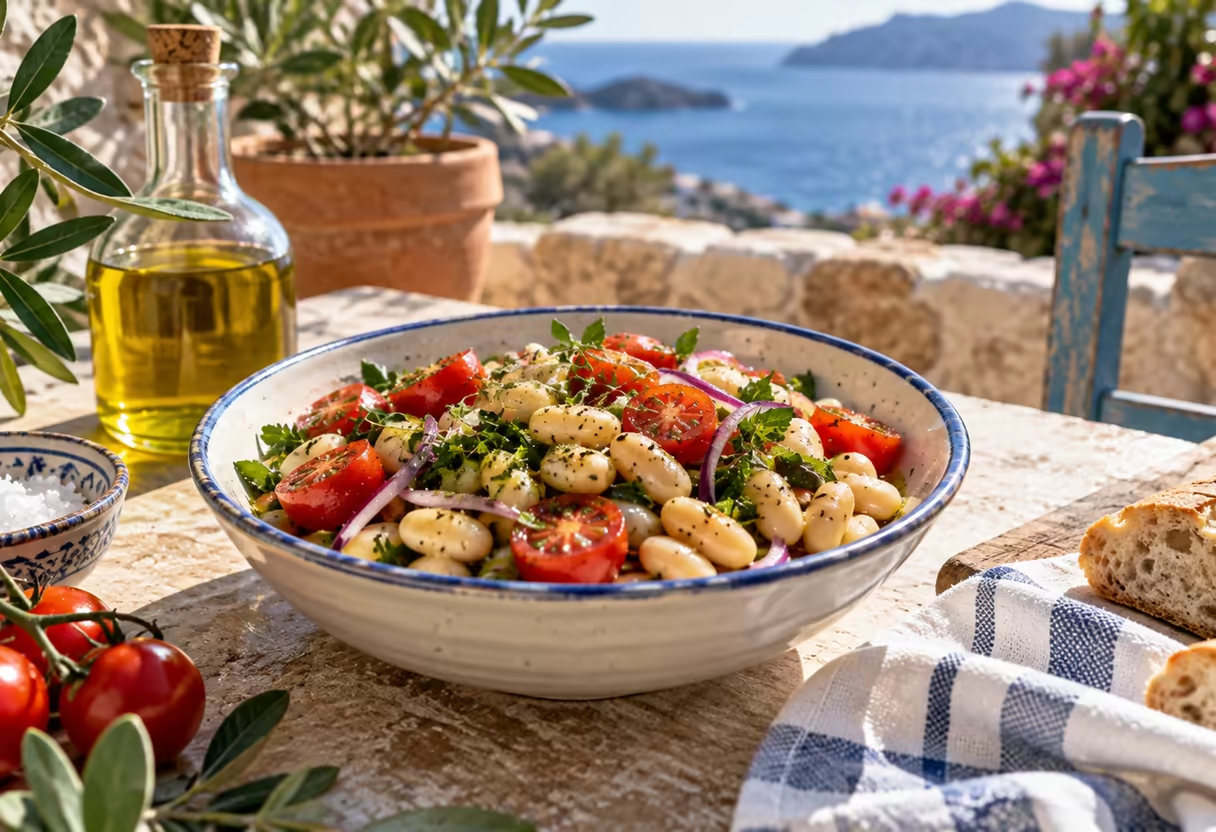
In practical terms, Mediterranean-style eating usually centers on vegetables, legumes, whole grains, nuts and olive oil, with fish commonly included. But the review accepted different validated scores. The accessible abstract does not define a point as one common quantity of any particular food.
For that reason, there is no grams-per-day prescription to extract from this review. Nor can we responsibly turn the pooled result into “eat one extra portion and gain this much protection.” A dietary score summarizes several choices, and its meaning depends on the scoring system.
A large review, not 54 diet experiments
The researchers screened 5,229 records and included studies with follow-up ranging from 2 to 60 years. Their literature search ended on February 28, 2024, so publication in 2026 does not mean these are all newly collected data.
They used a random-effects analysis, which allows for differences between studies, and rated overall certainty as moderate using NutriGrade. That is a reasonable signal of confidence in an association, not a guarantee that diet alone caused it.
People who score highly on a dietary questionnaire may also differ in physical activity, smoking, income, access to care and other habits. Statistical adjustment can help, but it cannot remove every difference. Self-reported diets also contain measurement error and may change during a long follow-up.
What the 4% can and cannot tell us
The reported reduction is relative, not an absolute four-percentage-point drop in someone’s risk of dying. Absolute risk depends on age, health and the period being considered. Because the studies followed different populations for very different lengths of time, this review does not provide one personal risk reduction or a number of extra years of life.
It also does not identify a single protective ingredient. The useful takeaway is the consistency of the broader pattern: across many cohorts, closer Mediterranean-style eating was associated with lower mortality. That supports looking at the overall diet rather than treating olive oil, nuts or any other food as a stand-alone longevity intervention.
Funding and competing interests: The paper declares no competing interests. Its disclosure states that coauthor Massimo Volpe is supported by an Italian Ministry of Health grant (Ricerca Corrente). That is not a declaration that every underlying cohort was free of bias.
Source check: the study’s abstract and disclosure were verified in PubMed. The full text was not accessible for this report, so score-specific food quantities and other unreported details are not inferred.
This article is for general education and is not medical advice.