A Brazilian trial ran the same nuts past the same women twice — once over three hours, once over eight weeks — and got two different answers. That split is the most useful thing in the paper, and it is a good illustration of why a single metabolic measurement should never be sold as a weight-loss result.
The trial, run by the energy metabolism laboratory at the Universidade Federal de Viçosa and published in Nutrition, Metabolism and Cardiovascular Diseases, recruited women aged 20 to 55 with a BMI of at least 27 kg/m², a waist of at least 80 cm and body fat of at least 32%, plus at least one further cardiometabolic risk marker such as triglycerides of 150 mg/dL or above, blood pressure from 130/85 mmHg, or fasting glucose from 100 mg/dL. It was registered in advance with the Brazilian clinical trials registry, which lists a target of 52 women, 26 per group; the published abstract does not state how many were analysed in the end.
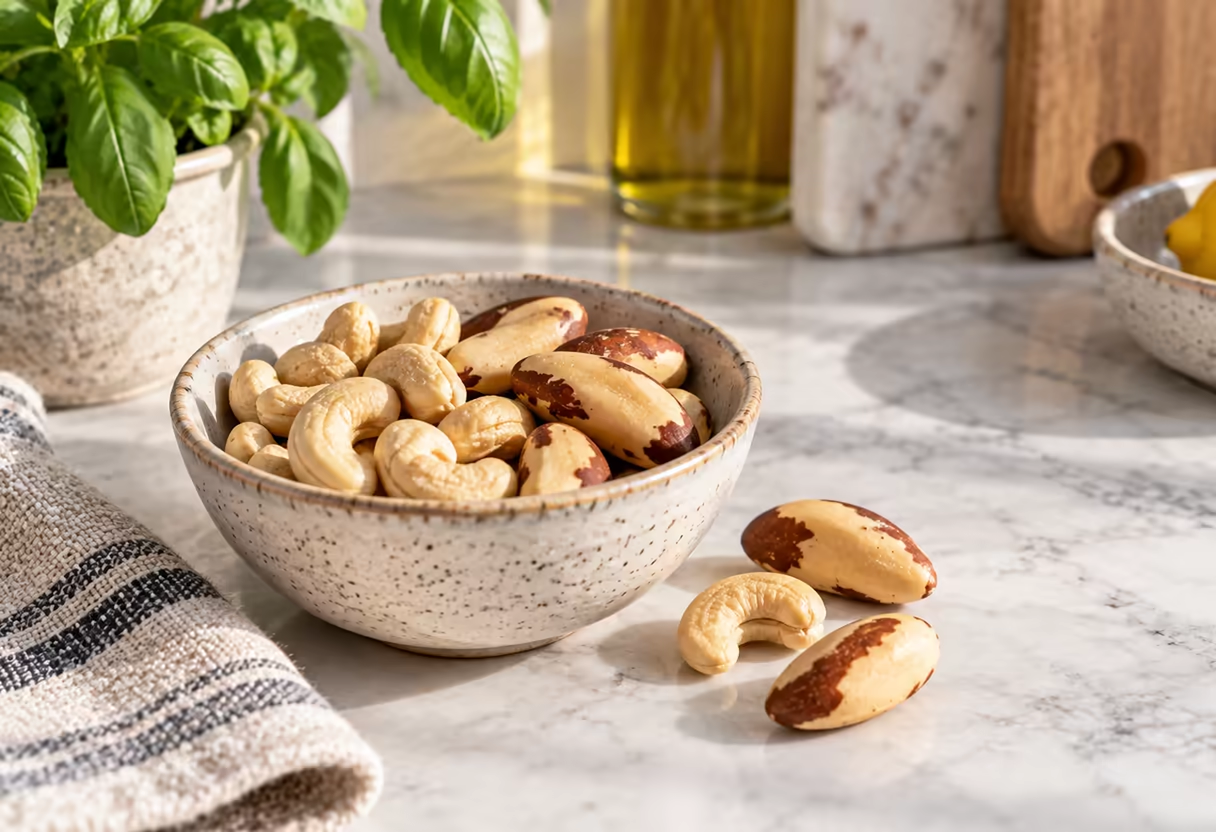
Over three hours, the nuts did something measurable. Participants drank a beverage containing 30 g of cashew nuts plus 15 g of Brazil nuts, or a control beverage, and had their energy metabolism tracked for up to three hours afterwards. Fat oxidation — the rate at which the body burns fat rather than carbohydrate — came out higher after the nut drink: 47.53 ± 5.78 mg/min versus 27.93 ± 6.98 mg/min for the control, p = 0.048. That is a clear difference on the measurement, and it only just clears the usual significance threshold.
Worth keeping in proportion, though. That 45 g of nuts carries roughly 265 kcal of its own, using standard food-composition values. A three-hour uptick in the proportion of fat being burned is a shift in fuel mix, not a calorie deficit, and the study never claimed otherwise.
Over eight weeks, the difference disappeared. In the longer arm, one group ate 45 g of mixed nuts a day inside a diet cut by 500 kcal; the other followed the same 500-kcal deficit without nuts. Fasting fat oxidation rose in the nut group (+16.0 ± 7.0 mg/min) and fell in the control group (−5.0 ± 6.0 mg/min) — but the difference between the groups was not statistically significant, and the researchers say so plainly. Every other acute and chronic marker of energy metabolism they measured came out the same way: no significant difference between groups.
How to read a result like that. Two groups moving in opposite directions looks like an effect, and with a group size in the mid-twenties it may well be one that a larger trial would confirm. But "not significant" here means the data cannot separate that pattern from chance, and the honest summary is the one the authors wrote: acute intake raised postprandial fat oxidation; chronic intake inside an energy-restricted diet did not change energy metabolism markers.
The practical read. If you are eating in a deficit, this trial gives you no reason to expect a daily handful of cashews and Brazil nuts to speed up your metabolism over a couple of months. It also gives you no reason to avoid them: swapping 265 kcal of your allowance into nuts did not make anything worse over eight weeks, and nuts bring protein, unsaturated fat, fibre and — in the case of Brazil nuts — a large amount of selenium, which is its own reason to keep the portion small rather than large. The trial says nothing about weight, body composition or blood markers here; it measured how the body burns fuel, and that is all it can speak to.
No competing interests. The authors declare none, and the work came out of a university laboratory rather than the nut industry — which is not the norm in nut research and is worth crediting.
Medical note. This article provides general education and information about health and related subjects. The information is not medical advice and should not be used to diagnose or treat health problems or conditions. Always consult with a qualified healthcare professional for medical advice and treatment.