Fifty adults with a genetic condition that keeps their LDL cholesterol high no matter what they eat were fed, for four weeks at a time, exactly what researchers put in front of them — and diet still moved the number by nearly a fifth. The condition is heterozygous familial hypercholesterolemia (HeFH), an inherited fault in how the body clears LDL particles from the blood. It affects an estimated 34 million people worldwide and drives heart attacks and strokes decades earlier than in the general population. Diet is often dismissed as a minor factor here, because the underlying problem is genetic. A trial from Université Laval in Quebec, published in Nature Communications, put that assumption to the test.
The design left nothing to self-report. In a randomized crossover, each of the 50 participants (51 enrolled; one dropped out in week one) ate a whole food, plant-based diet for four weeks and a standard North American-style diet for four weeks, in random order, with a 2-to-4-week break between. Every gram of food was provided by the research team — nothing was eyeballed or logged from memory — and both diets were built to deliver identical calories, with 50% from carbohydrate, 15% from protein and 35% from fat. Compliance came in above 99% on both diets. Ages ranged from 19 to 58, with a near-even split of women (52%) and men (48%). Most were on cholesterol-lowering medication going in — 22% on a statin alone, 46% on a statin plus ezetimibe, 24% on a PCSK9 inhibitor — and that medication was paused for the trial, so what's being measured here is diet against diet, not diet on top of a drug.
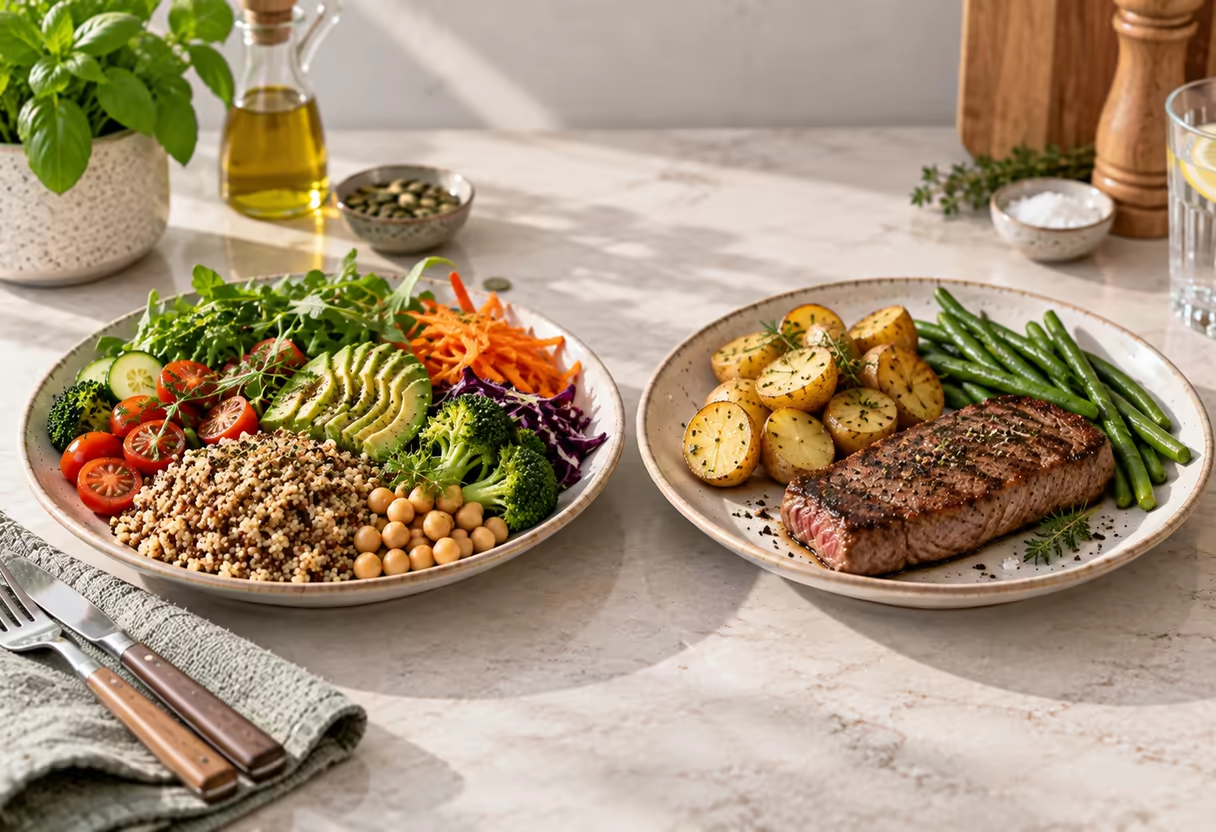
The only thing that changed between the two diets was food quality, and it moved a lot. The plant-based menu delivered roughly 48 grams of fiber a day against 22 grams on the standard diet, cut saturated fat from 12% of calories to 6.5%, and lowered dietary cholesterol — built around vegetables, legumes, whole grains and minimal red meat (once a week, with two fully meatless days), using canola oil rather than butter or other solid fats.
LDL cholesterol fell by 1.28 mmol/L — about 50 mg/dL — a 17.9% relative reduction (95% CI −21.7% to −14.3%, P<0.0001). Mean levels went from 7.14 mmol/L on the standard diet to 5.86 mmol/L on the plant-based one. Total cholesterol dropped 16.2%, non-HDL cholesterol 17.5%, and apolipoprotein B — arguably the more decision-relevant number, since it counts the actual particles that deposit cholesterol in artery walls — fell 14.8% (95% CI −18.0% to −11.6%, P<0.0001). Ten percent of participants saw their LDL-C drop by 30% or more on the plant-based diet; an equal number saw it rise instead, a reminder that individual response to diet varies even within a single genetic condition.
Not everything moved, and the honest reporting of what didn't is worth noting. Lp(a) — a cholesterol-carrying particle that diet generally can't touch — showed no change (+2.3%, P=0.42), which is expected and consistent with other trials. C-reactive protein, fasting glucose, fasting insulin and HbA1c were also unaffected. Blood pressure dropped by about 2 mmHg, both systolic and diastolic. HDL cholesterol fell 8.5% and its carrier protein ApoA1 fell 7.4% — a real trade-off, likely driven by the same drop in saturated fat that lowered LDL, since saturated fat raises both. The researchers note the total-cholesterol-to-HDL ratio still improved overall, because the atherogenic lipids fell by more than the protective ones.
One confound the authors report plainly: both diets caused weight loss, despite being designed not to. Participants lost 0.82% of body weight on the standard diet and 1.30% on the plant-based one — a small but statistically significant difference (P=0.03) that could account for part of the lipid benefit, on top of the food-quality changes themselves. The paper doesn't fully separate the two.
Put together, the researchers estimate the plant-based diet lowered 10-year cardiovascular risk by 11.9% relative to the standard diet (95% CI −19.4% to −3.6%, P=0.007). They found no evidence that the size of the LDL response depended on sex, age, or which of the nine possible HeFH gene variants a participant carried — the diet worked similarly across the genetic subtypes tested.
What this doesn't show. Four weeks is short; nobody knows whether the effect holds, grows, or fades over years, or what happens to adherence once meals aren't prepared and delivered by a research kitchen. Medication was paused rather than layered on top of diet, so this trial says nothing about how much additional benefit a plant-based diet adds for someone who stays on their statin or PCSK9 inhibitor — which is how diet change is actually recommended in practice. And even after the drop, LDL-C in this group remained well above target for most participants; diet narrowed the gap, it didn't close it. The paper's own conclusion is that this strengthens diet's place as a foundation of HeFH care, not a replacement for medication.
Funding and disclosures. The trial was funded by the Canadian Institutes of Health Research, a public body — no industry money. The senior author reports research grants and consulting fees from Dairy Farmers of Canada and the Weston Family Foundation, disclosed as unrelated to this study; nothing ties to a plant-food industry interest.
Medical note. This article provides general education and information about health and related subjects. The information is not medical advice and should not be used to diagnose or treat health problems or conditions. Always consult with a qualified healthcare professional for medical advice and treatment, especially before changing a treatment plan for a diagnosed genetic condition.