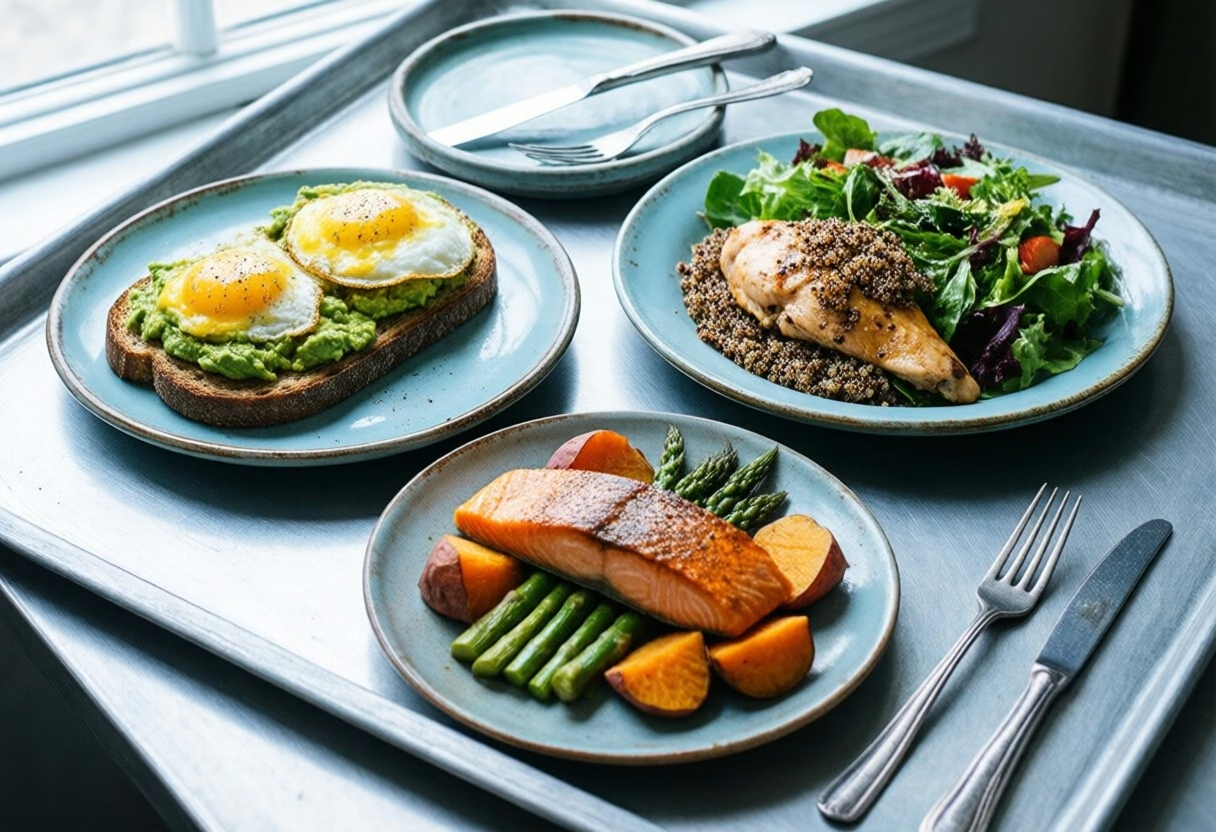
Two groups of women ate the same amount of protein every day for 16 weeks. The only difference was when. One group spread it evenly across breakfast, lunch and dinner; the other loaded most of it into dinner, the way most people actually eat. The group that spread it out ended up eating nearly 18 grams fewer energy-dense snacks in a laboratory test — and wanted them less.
The design. Researchers at the USDA's Grand Forks Human Nutrition Research Center, working with Indiana University, ran a 16-week randomised parallel trial in healthy women aged 20 to 44 with a BMI between 28 and 45. The first eight weeks were a supervised weight-loss phase: 20% energy restriction, with every item of food provided. The second eight weeks put participants back in charge of their own kitchens, with instructions to keep their assigned protein pattern and energy intake. Forty-four women completed the study and were analysed. Lunch is where the two patterns diverged most visibly: 35 g of protein in the even group against 20 g in the skewed group.
What they measured, and why it is unusual. Rather than simply asking people what they ate, the team measured how hard participants would work for snack food. Two hours after lunch, women sat at a computer task where effort earned either energy-dense snacks or a preferred sedentary activity — a standard way of quantifying the "relative reinforcing value" of food, essentially how much pull it has. A score above 0.5 means the snacks are winning.
The results. The even-distribution group scored 0.44 ± 0.04; the skewed group scored 0.55 ± 0.04 (P = .0476). One group was, on average, below the line where snacks beat the alternative; the other was above it. When it came to actually eating, the number of snacks earned did not differ between groups (P = .2338), but consumption did: 44.3 ± 5.2 g in the even group versus 62.0 ± 5.1 g in the skewed group (P = .0197). The authors read this as a difference in food-related motivation and satiety, not in willpower.
Take it seriously, but not too seriously. Forty-four completers is a small trial, and both key P values sit close to the 0.05 line — the sort of result that needs replication before anyone builds a rule on it. The participants were all women in a fairly narrow age band, recruited in a single American town over a stretch that included a long pandemic pause. And the outcome is grams of snack food in a laboratory setting, not weight on a scale months later; the study was not designed to show that even protein distribution makes you lose more weight, and it does not show that.
Why it is still worth knowing. Most dietary advice about protein argues over the daily total. This trial holds the total fixed and moves only the timing, which isolates a variable almost nobody controls deliberately — and the typical Western pattern, a light breakfast and a protein-heavy dinner, is the one that came off worse. If you are already eating in a deficit and find yourself grazing in the afternoon, moving protein forward into breakfast and lunch costs nothing, requires no new foods, and has at least one controlled trial pointing in its favour. The research was publicly funded through the USDA, with no industry sponsor behind it.
Medical note. This article provides general education and information about health and related subjects. The information is not medical advice and should not be used to diagnose or treat health problems or conditions. Always consult with a qualified healthcare professional for medical advice and treatment.